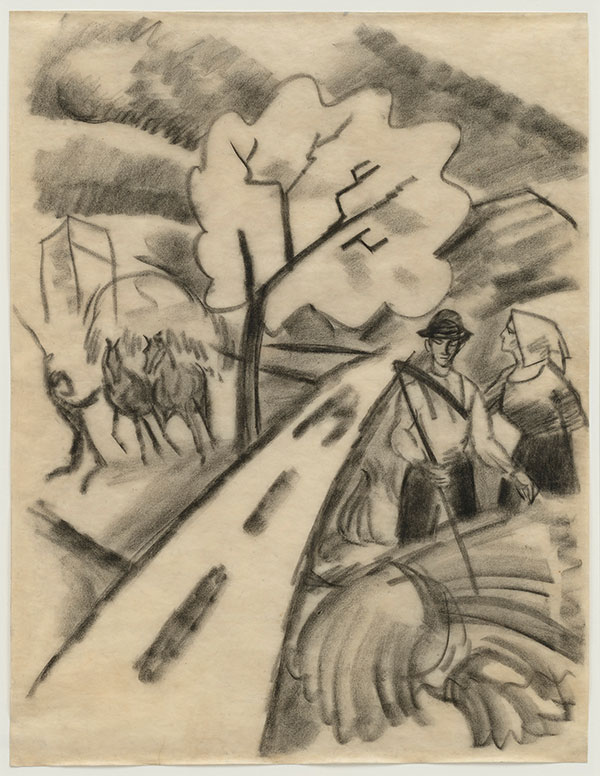
The drawing Ernte (Harvest) by August Macke, originally part of Walter Kaesbach’s donation to the City of Mönchengladbach in 1928, has been reacquired for the Museum Abteiberg collection:
August Macke (1887–1914)
Ernte (Harvest), 1911
62.1 x 47.7 cm
wax crayon on tracing paper
Museum Abteiberg, Mönchengladbach, inv. no. 10755 [cat. raisonné no. 864]
In 1937, the National Socialists confiscated works of art from public museums as so-called “degenerate art,” including Expressionist works donated by Walter Kaesbach to the then Städtisches Museum Mönchengladbach, among them August Macke’s drawing. The National Socialist “Degenerate art” campaign involved the systematic confiscation of modern works of art by the regime beginning in 1937. Unlike in cases of Nazi-looted art, the state largely seized works from its own museum holdings; a law enacted in 1938 granted it legal authority over them. After the Second World War, the Allied Control Council left this law in place, and no restitution was provided for. Ownership changes resulting from the confiscation remain legally recognized to this day.
The acquisition was supported by the Ministry of Culture and Science of the State of North Rhine-Westphalia and the Kulturstiftung der Länder. The re-inclusion of Macke’s drawing in the collection is significant both for the collection and in light of the museum’s history: in 1922/28, Walter Kaesbach’s Donation in Mönchengladbach laid the groundwork for a museum of contemporary art—an identity that Museum Abteiberg continues to uphold today.
Walter Kaesbach Foundation 1922/28 – 1937 “Degenerate art” campaign
In 1922, Walter Kaesbach (1879–1961), a native of Mönchengladbach, donated 97 Expressionist works by Lyonel Feininger, Erich Heckel, Heinrich Nauen, Emil Nolde, and Christian Rohlfs to his hometown. The works were initially placed with a specially established art association; in 1928, they were donated to the City of Mönchengladbach. In the process, Kaesbach reduced the group to 76 works while also expanding it to include artists such as Ernst Ludwig Kirchner, Wilhelm Lehmbruck, and August Macke, including the now reacquired drawing—a gift from Alfred Hess. With Hess’s support, Kaesbach had established Expressionism at the Städtisches Museum in Erfurt, which he had directed since 1920. In 1924, Kaesbach was appointed director of the Kunstakademie Düsseldorf, where he played a key role in shaping avant-garde teaching and appointed, among others, Ewald Mataré and Paul Klee as professors. Kaesbach was dismissed by the National Socialists in 1933.
In 1937, the majority of the works from the Kaesbach donation to Mönchengladbach were confiscated as part of the National Socialist “Degenerate art” campaign. Many of these works are still missing today. After 1945, the museum was initially able to reacquire three works: in 1965, the painting Roter Hirte mit Tieren (Red Shepherd with Animals) by Heinrich Campendonk, as a long-term loan from the State of North Rhine-Westphalia; in 1966, Christian Rohlfs’s Gottvater, den ersten Menschen modellierend (God the Father Modeling the First Human), with support from Westdeutscher Rundfunk; and in 1979, the painting Flandrische Ebene (Flemish Plain) by Erich Heckel, with support from the State of North Rhine-Westphalia. In 2024, the drawing by August Macke was also returned to the collection.
Museum Abteiberg has for many years conducted extensive research on the Walter Kaesbach donation and its significance for the museum’s and collection history. In 2022, it presented the exhibition 100 Years Walter Kaesbach Donation: Expressionism at Museum Abteiberg. The presentation brought together both works from the donation that remained in the museum after 1937 and those later reacquired. To trace the whereabouts of the missing works, the museum established a cooperation with the “Degenerate Art” Research Center (headed by Meike Hoffmann) within the Freie Universität Berlin Art History Department. The exhibition also presented post-1945 acquisitions of Expressionist art. In response to the resulting gap in the collection, Heinrich Dattenberg, the museum’s first full-time director in Mönchengladbach, continued his efforts into the 1960s to build a new Expressionist collection.
August Macke’s Ernte
August Macke’s drawing Ernte (Harvest), createdin 1911 in Kandern in the Black Forest, holds a distinctive place within his overall body of work: motifs drawn from rural and agricultural contexts are comparatively rare in his œuvre when set against those from the urban environment. Urban subjects appear, for example, in three pencil and charcoal drawings from 1913 and 1914, which were acquired for the collection of the Städtisches Museum Mönchengladbach in 1954. The unusually large-format drawing Ernte is described in the catalogue raisonné by Ursula Heiderich as a preparatory work for the lost painting of the same name; at the same time, its fully realized, image-filling composition and compelling dynamism allow it to be understood as an autonomous work within the artist’s extensive body of drawings.
Provenance research – “object biography” of the drawing Ernte
August Macke’s Ernte will be on view from April 23, 2026, in the Provenance Research study room as part of the current collection display at Museum Abteiberg. The museum developed the study room in 2022 in connection with the exhibition 100 Years Walter Kaesbach Donation: Expressionism at Museum Abteiberg, building on a collaboration with Heinrich Heine University Düsseldorf and its degree program in Art Education and Cultural Management. It explores the background of the National Socialist “Degenerate art” campaign and presents, by way of example, the provenance history of a painting by Ernst Ludwig Kirchner acquired by the museum in 1964. In this context, the museum also shows Ernte and traces the drawing’s “object biography.”
After its confiscation in 1937, August Macke’s work was initially kept at Schloss Schönhausen, a palace in Berlin where the National Socialists stored artworks deemed “internationally marketable.” In 1939, the collectors Emanuel and Sofie Fohn (Rome/Munich) acquired it through an exchange with the Reich Ministry of Public Enlightenment and Propaganda; Sofie Fohn sold it on the art market in 1958. The drawing subsequently changed hands several times, passing through the art trade and private collections in Germany and abroad. Most recently, it was secured ahead of its acquisition by the museum, with the assistance of Michael Reisen-Hall, Mönchengladbach, to prevent a further sale.
A further thematic focus in the Provenance Research study room addresses the Nazi looting of art from Jewish citizens between 1933 and 1945. From the time of the National Socialists’ seizure of power in 1933, the regime systematically deprived Jewish citizens in particular of their rights and property. From 2016 to 2018, Museum Abteiberg examined the provenance of works in its collection acquired after 1945 as part of a research project funded by the German Lost Art Foundation, with the aim of clarifying whether they were subject to Nazi-era persecution-related dispossession.
Abb.: August Macke, Ernte (Harvest), 1911, Museum Abteiberg Mönchengladbach, Photo: Achim Kukulies